
Product Guide
10G to 800G: Choosing SFP+, SFP28, QSFP56, QSFP-DD, OSFP Transceivers
Published July 20, 2026
A practical decision tree for switch-side transceiver selection. Match lane count, modulation, and form factor to your reach and power budget.
Form factor by lane bandwidth
Every pluggable transceiver is a number of electrical lanes × the bandwidth per lane:
SFP+ — 1 lane × 10 G NRZ → 10 G aggregate.
SFP28 — 1 lane × 25 G NRZ → 25 G aggregate.
QSFP56 — 4 lanes × 50 G PAM4 → 200 G aggregate.
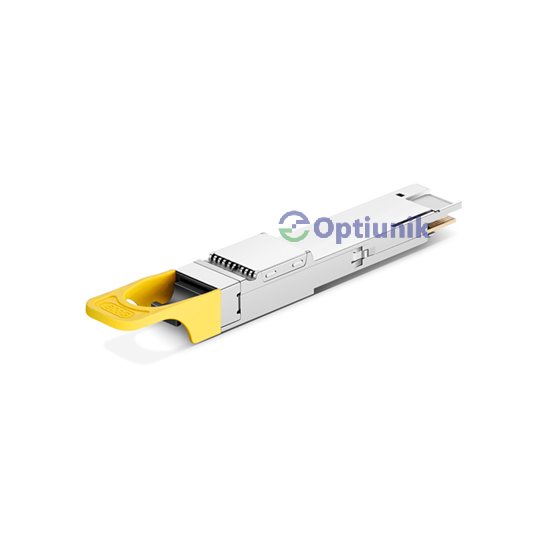
QSFP-DD — 8 lanes × 50 G PAM4 → 400 G; mechanically backward-compatible
with QSFP+ and QSFP28 ports.
OSFP — 8 lanes × 100 G PAM4 → 800 G; a slightly larger cage than
QSFP-DD with built-in heat-sink anchoring for the higher power envelope.
Reach class: SR, DR, FR, LR, ER, ZR
Reach is encoded in the model code suffix. For 400 G QSFP-DD as an example:
Code | Fiber | Reach | Typical use |
|---|---|---|---|
DR4 | 4× single-mode duplex MPO | 500 m | Datacenter spine-leaf |
FR4 | duplex LC single-mode | 2 km | Pod-to-pod within DC |
LR4 | duplex LC single-mode | 10 km | DCI-short |
LR8 | duplex LC single-mode | 10 km | LR4 alternative |
ZR/ZR+ | duplex LC single-mode | 80–120 km | Coherent DWDM metro |
Power and cooling
A 400 G QSFP-DD ZR runs at 15–18 W. Switches certified for 400 G ZR usually cap at ~16 W per port due to airflow constraints. Always confirm the switch vendor's per-port power budget before committing to ZR optics on every port — many deployments mix ZR-on-uplink and FR4-on-fabric to fit under the per-line-card thermal envelope.
DOM and compatibility coding
Optiunik transceivers ship pre-coded for the major switch OS vendors (Cisco, Arista, Juniper, Mellanox/NVIDIA, HPE, Dell, H3C). Specify the target platform when ordering — re-coding after delivery requires the module to be physically returned.
Ready to source from the factory?
Send us your BOM, target price, and shipping terms. Our team replies within one business day.